
Art Center Canvas
Website Redesign
2024
Role
Design Lead
Services
Web Design · UX/UI · Art Direction · Content Strategy · QA
Art Center Canvas provides software and support designed specifically for arts education centers, helping organizations manage the operational side of their programs.
As the platform evolved, its website needed to do a better job of communicating what Canvas offers while also reflecting the organization’s brand and positioning within the arts education space.
The Challenge
Making a complex platform easier to understand
The existing website made it difficult for visitors to quickly understand what the platform offered, how it could support their organization, and why they should take the next step.
The redesign needed to create a clearer path from learning about the platform to understanding its value and requesting a demo.
Strengthening brand positioning
Beyond communicating the software, the website needed to better represent the Art Center Canvas brand. The existing experience was text-heavy and lacked visual context, making it difficult to connect with the people and organizations the business serves.


My Role
As Design Lead, I:
Led the website redesign from initial visual direction through implementation and launch.
Translated Art Center Canvas's existing brand guidelines into a cohesive digital experience.
Designed core website pages and landing page layouts, establishing flexible patterns that could be carried across the site.
Partnered closely with the developer throughout implementation, providing design QA through launch and post-launch.
Key Decisions
01. Lead with a clearer product story
Canvas needed to quickly communicate what the platform is, who it serves, and why it matters. The experience needed to make a complex software offering easier to understand without overwhelming visitors.
02. Balance product education with brand positioning
The website needed to do more than explain the platform. It also needed to strengthen Canvas's position within the arts education space and create a brand experience that felt distinctive and credible.
03. Make the software tangible
Because Canvas is a software product, the experience needed to give prospective customers a better sense of what the platform actually offers and how it could support their organization.
04. Create a flexible foundation for growth
The site needed to support more content and future marketing needs without requiring a completely new approach each time. A flexible structure and reusable patterns would make it easier to expand the experience over time.
Design Solutions
Creating clarity and confidence
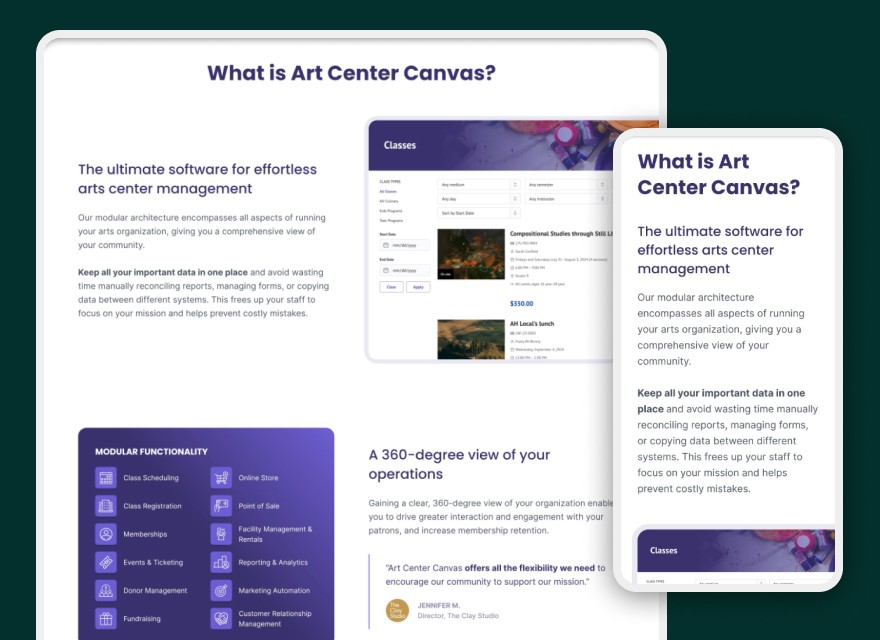
I restructured the content hierarchy and page layouts to make the platform easier to understand, helping visitors quickly grasp its capabilities and the value it provides.
Product visuals and UI representations brought the software to life, giving potential customers a clearer sense of how the platform could support their organization and encouraging them to consider the next step toward a demo.

Bringing the brand to life
Using the existing brand guidelines as a foundation, I translated the brand into a clean, simple, and modern digital experience.
I introduced stronger visual storytelling and imagery to create a more approachable experience, strengthen brand positioning, and better connect Art Center Canvas with the people and organizations it serves.


Building a flexible foundation
I established flexible page structures and content patterns that could be carried across the site and adapted for future expansion.
The system supported the development of additional pages and landing page experiences, giving Art Center Canvas a foundation for ongoing product education, brand communication, and growth.
Impact
A clearer foundation for product education and brand growth
The redesign established a more structured, approachable, and cohesive digital experience for Art Center Canvas.
Improved content clarity: Restructured information and page layouts to make the platform easier to understand.
Strengthened brand positioning: Translated existing brand guidelines into a more elevated and cohesive digital experience.
Supported product consideration: Introduced product visuals and UI representations to help potential customers understand the software and envision its value.
Built for future growth: Established flexible design patterns to support ongoing content development and landing page expansion.
Impact statements reflect the design improvements and deliverables described in this case study. Quantitative performance outcomes were not provided.